
What Is a PMP® Process Chart?
The PMP Process Chart is a visual framework that helps project managers understand how project management activities are organized throughout a project.
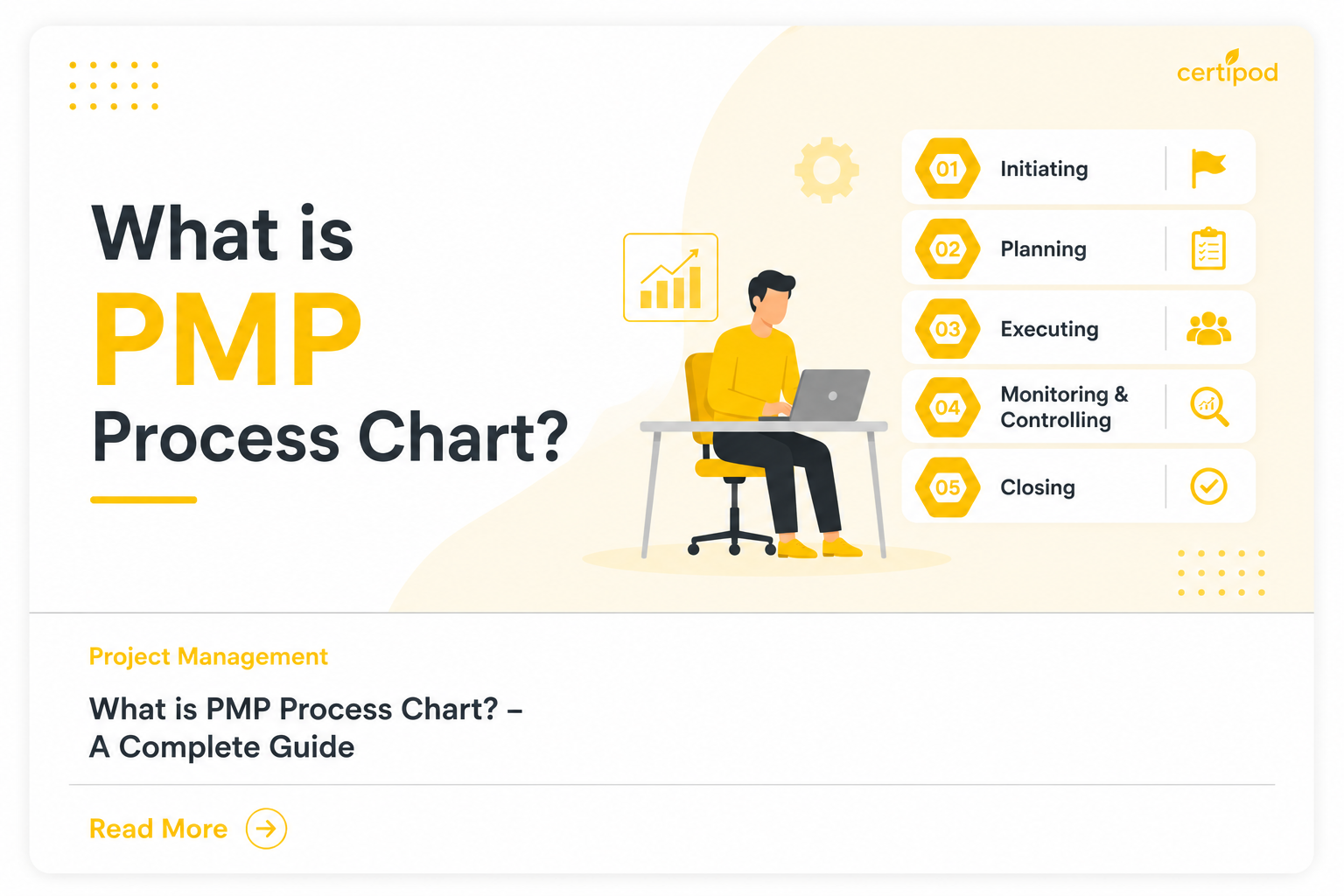
Traditionally, it organizes 49 project management processes into five Process Groups:
Initiating → Planning → Executing → Monitoring & Controlling → Closing
Understanding this flow can help PMP® candidates connect different project management activities instead of simply memorizing individual concepts.
5 PMP® Process Groups
1. Initiating
This is where the project or project phase begins. The objectives, key stakeholders, and overall purpose of the project are identified.
2. Planning
The project manager and team determine what needs to be done and how it will be accomplished. This includes planning scope, schedule, cost, risk, resources, communication, and other areas.
3. Executing
The project team performs the planned work. The project manager coordinates resources, manages communication, engages stakeholders, and supports successful delivery.
4. Monitoring & Controlling
Project performance is continuously reviewed. The project manager identifies issues or variances and determines whether changes or corrective actions are required.
5. Closing
The project or phase is formally completed, deliverables are finalized, and necessary closure activities are performed.
Is the PMP® Process Chart Important for the PMP Exam?
Yes, but candidates should focus on understanding rather than only memorizing the 49 processes.
The updated PMP® exam evaluates candidates across People, Process, and Business Environment and includes predictive, Agile/adaptive, and hybrid approaches. Therefore, understanding how processes connect and what a project manager should do in different situations is more valuable than memorization alone.
How to Study the PMP® Process Chart
Start by remembering this simple sequence:
Initiate → Plan → Execute → Monitor & Control → Close
Then understand what happens within each group and how one activity affects another. Practice scenario-based questions to learn what the project manager should do next in different situations.
Conclusion
The PMP Process Chart provides a structured way to understand traditional project management. The five Process Groups help candidates see how a project progresses from its beginning to completion.
For PMP® exam preparation, use the chart to understand the project management flow rather than trying to memorize everything word for word.